![]() |
Posts Tagged ‘Fish-Shaped Submersible Build-up’ »
Completed » The Fantastical Fish-Shaped Submersible! »
Without further adieu, I present to you FichtenFoo’s Fantastical Fish-Shaped Submersible! Enjoy the pics of my finished sub as they’re the best I’ve ever taken I think. I didn’t even need to color correct which is a total bonus. If you’re interested in getting on the list to order the early 2011 3rd Edition, click here. The 1st Edition is sold-out and the 2nd is reserved and then some. Thanks to all of you that helped make this possible and ordered the 1st two runs of subs.
In Progress » Fish Sub » Copper Patina »
My paint arrived! So I was able to paint the fins the metallic greenish color I wanted. I achieved the color by mixing Mr. Metal Color Aluminum, Bronze, and Brass. Once that was done, I was able to build and affix the fins to their various mounting points and start the much debated weathering.
Some folks wanted me to stop after my last post because let’s face it, that was a beautiful copper finish. I was torn, but decided that I’ll build another fish later and make it shiny since I already have the mounting hole on the side of this.
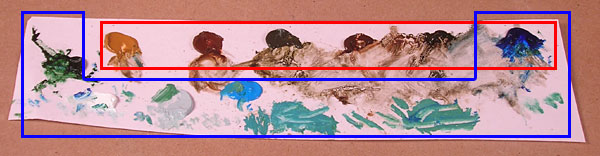
To start off, I applied 502 Abteilung oil paints with a brush randomly with odorless turpenoid. While still wet I dabbed them with a piece of sponge to remove brush strokes and give it more texture/random splotchiness. After it dried a bit I applied a semi-gloss coat of Future over everything. The colors used for this step were: German Ochre, Dark Rust, Wash Brown, Industrial Earth, Faded Navy Blue, and Shadow Brown. (red pallet below)
After the clear-coat cured a bit (3-4 hours) I used more 502 Abteilung oil paints (blue pallet below) to apply the random splotches of blue green patina. For this I did a combination of the discoloration technique and the aforementioned sponging. The colors used for this step were: Faded Navy Blue, Gundam Blue, Faded Green, German Grey Highlight and Snow White. I used the faded green, german grey highlight and gundam blue to mix up a base patina color as seen in the pallet paper I used below.
Again, I’m pretty happy with the results. The patina colors look better in person so I’ll try to take better pics later. There’s more depth and vibrancy to them than seen here. Tomorrow I’ll give this a satin coat and do some pin washes to deepen some panel lines. Below is the scrap of pallet paper I used for the oil paints. Read above for what I used.
In Progress » Fish Sub » Detail Painting »
Today I masked and painted the brass details on the fish. I used Parafilm ‘M’ for the portholes and fin mounts. All I’ve left to paint are the fins themselves, but I’m waiting on a paint order. I really like how it’s looking at this unweathered stage and am considering building another just like this, but putting it on a base as a display in a late 1800′s world fair.
In Progress » Fish Sub » Copper Clad Fish »
While typing out that copper test tutorial, I was also masking and painting the copper portions of the fish sub. Before that however I painted the engine and periscope. I started out by painting portions of the engine and periscope in Mr. Metal Color Bronze. I buffed these parts with a toothbrush, gave them a satin clearcoat of FFA, then masked and airbrushed most of the brass. After removing the masking I hand painted portions of the brass (and copper pipes) such as the trim of the big ballast tank and other smaller details.
I set these aside and began work on the main copper-clad fish submersible body. The painting is based on a colorscheme which I posted on the FichtenFoo facebook page a few days ago and now seen below:
You can see that my intent is to make some of the copper panels lighter and darker and in various patina-forming stages adding more depth and shading to the sub. The fins will eventually be some sort of tarnished brass/bronze alloy. At least that’s my barely feasible explanation as to why I want them that greenish brass tone. Mainly I just think it looks nice.
After finishing cleaning up the mounting rod hole I gave the sub another coat of dark gray Duplicolor primer, then a coat of the green self-etching primer.
Once cured I airbrushed on a mixture of Alclad II lacquers I call “bronze”. It’s a mixture of Steel, Copper and Aluminum which I first mixed up years ago for the Briegel. This gives me a nice dark metallic base to start from.
After the “bronze” dried I masked and randomly airbrushed on in vertical streaks some Alclad II copper which is pretty dark. Over that I streaked on some Mr. Metal Color copper which is a lighter tone and buffable to make it very shiny and natural looking.
Here it is at the first stage without the masking. It’s an interesting look, very cool for another project, but only halfway done for this one.
More masking and color applications and I got it to this stage. It’s hard to see the streaking and panel tone changes however in the image. Still not quite there however…
I wanted the panel color changes to be better defined so I masked again and over-sprayed some Alclad II Jet Exhaust. You can now see the improved panel definition.
And to show it off better, here it is in different lighting:
Next I’ll air and hand-brush the brass onto the porthole frame and other pipes and fittings.
Creating Copper Finishes »
This is going to be a long one… I’ve been thinking a lot about copper finishes lately for my Steampunk Fish-Shaped Submersible product. While considering how to achieve the look I wanted I realized that I have a LOT of copper products. Not sure why… maybe I’m looking for the perfect copper or just love metal finishes. Either way it’ll make for an interesting tutorial. Here’s a photo of all of the copper products that I have. (or at least those I remembered)
There’s Copper leaf, Sophisticated Finishes Copper Patina set, Apple Barrel “Pure Bronze” (looks like copper), Tamiya Acrylic Copper, Mr. Metal Color Copper (there’s also a Mr. Color Copper that I haven’t tried/bought), Alclad II Copper, Hawkeye/SnJ Copper Polishing Powder (they also make a paint that I’ve not tried/bought yet), Mig Productions Fantasy Pigments Copper, PearlEx Antique Copper and Sparkling Copper, Autumn Gold (copper) Rub n’ Buff, and of course copper sheet, rods and tubing. I’ve tried every one of these for one project or another. Every one is useful in some way, but combined they make some great colors.
Here’s a bunch of swatches that I made tests of the above on. These tests are to create a realistic looking copper with patina. Patina is a fine coating of oxide which forms on the surface of the metal when exposed which protects the surface from weathering. Here’s a link to the oft mentioned Future Floor Acrylic clear-coat mixes.
1: Sponged on Apple Barrel-style acrylic paints. Used Regency Blue, Bright Blue, Green Sage and White. Then dry-sponged white streaks vertically. Then applied Hawkeye/SnJ copper powder with finger. (doesn’t show up, not great look anyway)
1: Sponged on Apple Barrel-style acrylic paints. Used Regency Blue, Bright Blue, Green Sage and White. Then dry-sponged white streaks vertically. Applied Autumn Gold (copper) Rub ‘n Buff mixed with a touch of black oil paint using a somewhat dry-brush. Airbrushed flat coat of Future Floor Acrylic.
3: Primed with black spray paint. Painted with thinned Autumn Gold Rub ‘n Buff thinned with Odorless Mineral Spirits. Mineral Spirits started to eat primer unfortunately. Buffed with cotton t-shirt rag.
4: Primed with black spray paint. Airbrushed on Alclad II Jet Exhaust. Airbrushed on Alclad II Copper in a mottled light pattern.
5: Primed with black spray paint. Airbrushed on Alclad II Copper.
5A: Track Brown Mig Pigment blended in with Odorless Turpenoid.
5B: Coated half of #5A with Gloss Future Floor Acrylic.
6: Primed with black spray paint. Airbrushed on Alclad II Copper. Next a mixture of Zombie Green, Ashes, and Neptune Blue Mig Pigments was sprinkled/dabbed on with a brush. These were then blended with Odorless Turpenoid. Clear-coated with Satin Future Floor Acrylic.
7: Primed with black spray paint. Airbrushed with Mr. Metal Color Copper.
7A: Track Brown Mig Pigment washed on with Odorless Turpenoid. Next a mixture of Zombie Green, Ashes, and Neptune Blue Mig Pigments was washed on with Odorless Turpenoid. Coated in Satin Future Floor Acrylic.
7B: Coated half of #7A with Gloss Future Floor Acrylic.
8: Primed with black spray paint. Copper foil leaf applied.
8A: Bottom half of Swatch #8 was dipped in ammonia cleaner then left to air dry. I repeated this twice. A month later, the result is as seen. I love it, but I fear it’s unpredictability.
9: Primed with black spray paint. Copper foil leaf applied. This was then soaked in ammonia cleaner for a few days in a patina/tarnishing attempt. The only result was clean copper and a slight dissolving of the glue under the leaf making it shrivel/warp.
10: Primed with black spray paint. Sophisticated Finishes copper paint sponged on. When dry the patina solution was applied. The effect and look are not so great in my opinion, but maybe I did it wrong. The patina solution on it’s own works nicely on real copper though.
Here’s more shots of the above in various stages of completion.
Here’s some real copper (right) and brass (left) bits placed in salt water for 6 months as a test. Why so long? I forgot about the sealed jar!!!
The method I liked best from my test is that seen in swatches #5, #6 and #7. I’ll demonstrate this on the figure bust below:
Primed figure with flat black spray paint then airbrushed on Alclad II Copper. (above)
Track Brown Mig Pigment washed on with Odorless Turpenoid. Allow to dry fully then airbrush on a satin coat of Future Floor Acrylic mix. (above)
A mixture of Zombie Green, Ashes, and Neptune Blue Mig Pigments was sprinkled/dabbed on with a brush. These were then blended with Odorless Turpenoid. Finally it was clear-coated with Satin Future Floor Acrylic. (above)
Side View… (above)
Another Angle… (above)
Watch my Fish Sub Build-Up thread for more copper techniques as I’ll be documenting what I learned above as I apply it to an actual model. I’m sure there’s more methods and products than those I showed above. If you got one, send me a pic and process. If you make a copper product, contact me and send me a sample to review! I’ll add them to this post or if cool enough to an all new post.
In Progress » Fish Sub » “Man the Harpoons!” »
Since the interior was done I used some 5-minute epoxy to attach the head. Before gluing it on I masked the portholes with some tape and liquid mask from the inside. Both will be easy to remove later. I also drilled a hole for the mounting rod (square tube) on the side. I filled the hole with epoxy putty and inserted a tube of the same size as that on the base making sure it was oriented correctly so the sub looks level. Later I’ll remove the tube from the sub (leaving a square hole) and sand that panel/putty flush. Then I’ll be able to just slide the sub on and off the display base.
I also painted the foundry plate and unit numbers from the PE fret. I painted them with a few layers of Mr. Metal Color Bronze and Copper. Once dry I buffed them with a soft cloth and toothbrush which really makes this buffable paint shine as seen below. The foundry plate and left-most numbers 1 and 2 have been buffed. You can really see the difference in the color buffing makes.
Once the buffing was done I lightly sanded with 2000 and 6000 grit sandpaper to remove the upper layers letting the PE brass show through. I love the result. Also keep in mind the numbers are maybe 10mm tall.
In Progress » Fish Sub » Paint FINALLY! »
Yeah yeah yeah… I know! I’ve been slacking on the updates, but mostly because I haven’t had anything TO update. I’ve been taking a modeling vacation and trying to recharge the batteries so to speak.I also had to pack and ship out the first edition of the Fish Sub which was awesome and time consuming as well. The 2nd Edition will hopefully be ready in a month or so. Woo hoo! Anyway, back to the modeling…
After soaking the sub in Purple Power to remove mold release I was ready to do the parts clean-up to prepare the kit for paint. The clean-up went well and I only had to replace a couple rivets. (which I included with every kit, just in case. Your welcome!) The parts are all well-fitting and I only had a few spots that needed special attention. The most notable is the largest PE gauge plate. It didn’t fit immediately in it’s place as hoped/planned. However it’s a minor issue as all that needs done is to use a scriber to remove some material on the bottom of the two gauge tubes above it. Once a tiny amount of that is removed the face slides right in. The other part people had concerns about was the faucet knobs. To clean those up, simply rub the backs over some wet sandpaper until there is no more backing. The result is a knob with all the holes intact. The windows turned out very nice, but as usual with clear resin could benefit from a Future dip and some polishing to really make them shine.
I’m very happy with how the photoetch gauge faces turned out. I primed and painted them with a gloss black spray paint. Once dry I wet-sanded the faces with very fine (2000 grit) sandpaper. The reveals the brass underneath and leaves the black in the sunken areas. Then I gave them a couple Future dips to finish shining them up.
The interior of the sub needs painted first so after priming I painted it all with a semi-gloss white. Then I masked off the white in the head and sprayed on some Mr. Metal Color brass. I hand-painted the same Mr. brass paint on the other side of the interior. When dry I hand-painted on some copper pipe accents.
Once dry I sealed it with gloss then satin Future Floor Acrylic, then hand-painted the rest of the details like the read leather/wood seat and wood floor. Knob wheels were airbrushed with white then red and had a brass bolt-head hand-painted on. Finally everything was glued in place as you see above. Next I’ll mask the inside of the portholes, glue the head on, and fill the little hairline gap around the head so that light from my LED (see above image) does not leak out. The rim of the LED is painted in brass as well.
In Progress » Fish Sub » Sealife Encrustation »
Once the plaster had dried for the paddlewheel, it was time to start the sand and sea-life. I molded the rippled sand on the base using Ave’s Apoxie sculpt. Ripples were added with various sculpting tools. The warm neutral color of the dried Ave’s was a perfect base for the sand so I did not need to prime it once it cured. Instead I used an old toothbrush and used it to flick paint from the bristles onto the sand to give it a speckled and varied appearance. I first speckled on some lightly thinned Tamiya German Gray, then Earth, and finally White. I’m very happy with the results and it gives it some texture without resorting to over-scaled grits. Then the Celluclay rocks were painted with washes of dark gray and brown.
Once those had dried it was time to start applying the random sea-life reef growth over everything. First I made a nice pile of PLFH (pocket lint from HELL) using a plethora of scenery and modeling supplies. Here’s the a few pics instead of a list. As you can see it’s various turfs, grits and flocking.
Mix the PLFH with some water and matte acrylic gel medium then add a touch of paint to tint. My first application was too brown due to too much paint. You’re going for more of a wash here.I applied most of it with tweezers and a small dental tool shaped like a teeny spoon. You’ll notice it clumps nicely when mixed, but should be slightly wet and seepy. Poke and fluff it a bit with the tweezers when applying to make it more dimensional. You can add more water and brush it onto other surfaces for a thinner application of growth like I did for the wheel. I also misted on thinned matte medium and sprinkled the PLFH onto it.
Once the PLFH dries, you can further color and tint it with diluted acrylics as well as sponging on a variety of colors to suit the look you need. My refs showed just about every color in the rainbow and the sponging on of purples, reds, and ambers looks really nice.
After even more drying, you can begin to apply other bits of corals and sea-growths. I have more to add, but here’s what I’ve added so far…
The golden growths are bits of toilet tissue which I punched out and dipped into a solution of acrylic paint + prepared matte medium. Use tweezers to pinch and apply. Check out the ref pic below to see what I was going for. Once these dry they’ll lighten. You can then apply more thinned paint to achieve the desired color. I brushed on some thinned white along the edges as well. The branchy corals are light colored lichen bits. I also applied small bits of colored sponge and “dead” colored coarse turf. White barnacle bits were made by mixing white acrylic with fine gray ballast and speckling it on with a toothbrush. Later I’ll add some photoetch coral and anemone I’m having made.
In Progress » Fish Sub » Paddlewheel Part 2 »
I finished gluing the components of the paddlewheel together the other day using CA gel. It makes for a very interesting set-piece for the sub I think and was pretty fun to make. The difficult part was alignment which was made easier by taping everything onto my print-out and using it as a jig of sorts to glue it together.
For the base I used a cheap wooden unfinished jewelery box from Michaels. I cut the sides to make it have an uneven terrain then I used a wooden rasp file and really gouged the hell out of it to give it an old, cracked and beaten appearance. Then I used the same techniques I used for weathering the wood on the paddlewheel which was an india ink wash, gray acrylic drybrush then another ink wash. The end result is pretty nice and goes great with the overall feel of the scene.
To mount the paddlewheel and a few masts I first filled the base with large rocks for bulk the plenty of Plaster of Paris. The large mast will be the mount for the submarine. The rocks/coral so far on the base are just for bulk as later they’ll be covered with all sorts of ocean accretions. They’re made from celluclay mixed with sand, fine ballast, and tallus. Next I’ll use putty to form the rippled sand base before coating the ripples with some sort of grit.
The anchor is a white-metal piece from a model ship supplier. I added chain for effect. It was sprayed with primer, baking soda sprinkles, then flat black spraypaint so far. I also found really tiny shells at Michaels that will be part of the finished seascape.
In Progress » Fish Sub » Four-Story [Paddlewheel] »
I can’t start on my Fantastical Fish-Shaped Submersible kit yet, but I can start on the scenery to accompany it. I decided a while back that I wanted to do something underwater… a shipwreck of some sort. Initially I was going to do the bow of a pirate ship, but thought that a submerged section of a paddlewheel would be more visually interesting and unique. A mast and other objects will serve as the support rod holding the sub up in a swimming position.
I started out by gathering paddlewheel images online. After studying them for a bit I worked up a basic paddlewheel plan. Since it’s a sci-fi piece and highly degraded under the sea it doesn’t need to be an exact paddlewheel. A close approximation will do as a lot of it will be rusted away and coated in sea-life accretions obscuring details.
What I thought would be the most difficult part of the build so far has turned out to be the easiest. I had no idea at first how I would create the large metal support rings. I envisioned all sorts of apparatus to help me create them, but in the end a strip of styrene, an old sheet of particle board, and 3 pushpins was all I needed. I usually use pins and circle templates anyway to create smaller discs so I really should have thought of this sooner. The pins are a great scriber.
Once the parts were cut and sanded I glued slices of hex-rod for bolt-heads where the wooden planks would be. I then sprayed the parts with a thin coat of matte black spray paint and dusted them with baking soda. I quickly blew off the excess and gave the parts two more paint coats to seal. This makes a great rough texture for extreme rust.
To paint I used some bizarre side-effects of the hairspray technique to get a nice rust. I sprayed the black parts with a random coat of rust-colored flat Tamiya Acrylic mix. Then I sprayed the parts in hairspray which reacts with the paint coat adjusting tones and mottling the rust into a more believable rust look. Over the hairspray I sprayed a very thin coat of orange then removed much of it with a wet toothbrush to finish the rust look.
I cut the 48 paddlewheel planks from strips of 1/16″ x 3/16″ x 24″ basswood. Two lengths were needed to fit properly. I stained them in various dilutions of india ink and water to get different darknesses. Then I added a thin wash of brown to about 10 of the 48 planks. I also drybrushed a few of the planks with red acrylic to simulate the last of the paint that had yet to rot away. I need to weather these a bit more then start building the two large wheels. I need to get some wider planks at the LHS later to make the paddles.
|


Tired of expensive and slow web design services? Looking for quality design with a fast turnaround? Whether you need an all new design or updates to your existing site, I'll give you the same speed, professionalism, and attention to detail.