![]() |
Posts Tagged ‘YouTube’ »
In Progress » Millenium Falcon [1/72 Fine Molds Kit] » Discoloration Tutorial Pt 6 »
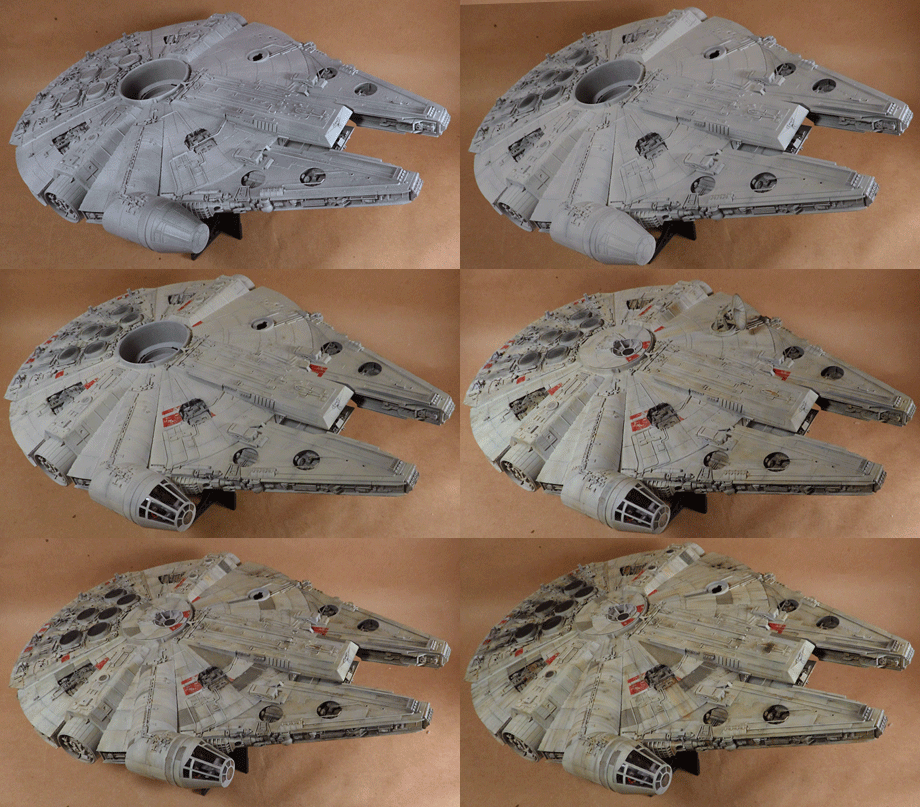
And here’s the last part of the Falcon painting and weathering tutorial. I hope you guys have enjoyed it. This last step is the application of pigments to enhance the engine grime and add blaster marks.
Here’s an animation showing the pics from start to finish. This shows the gradual application of grime and darkening of the kit. No need to start with a dark paint to get dirt.
In Progress » Millenium Falcon [1/72 Fine Molds Kit] » Discoloration Tutorial Pt 5 »
Been a few days since the last update, but the individual panel discoloration takes a bit of time, both in application and in drying. However the results are fabulous. Here’s the model with the panels completed.
Once they had dried it was time to apply the streaking. Here’s the tutorial followed by a few notes below.
Once the tutorial was over I worked on the rest of the model and decided to add some more defined dark streaks. These are done almost the same way. Paint them on very thinly with thinned oils then blend them with a dry or damp brush. Simple, but effective. Here’s the completed streaking. Next up: pigments.
In Progress » Millenium Falcon [1/72 Fine Molds Kit] » Discoloration Tutorial Pt 4 »
I needed to let the kit rest another day since it’s been really humid and dank here. That tends to make oil paint take longer to dry and I don’t have a large enough “hot-box” for this kit. (wood crate with a lightbulb for heat… speeds drying time) This next step will take me another day or two to complete not including drying time, but I wanted to show the video now.
This step is painting indevidual panels much like I did on the Tantive IV. This adds depth and dimension and a whole lot of visual interest. Here;s the video tutorial…
And here is the photo of what I did during and immediately following the video to provide more detail.
In Progress » Millenium Falcon [1/72 Fine Molds Kit] » Discoloration Tutorial Pt 3 »
Part three of this tutorial series covers painting the gray panels with oil paints. Pardon the stutters in the video. This was take two after a mishap involving oil paint on my favorite jeans and a screw-up trying to use liquid mask which the thinner involved apparently works great at removing.
Here’s the completed vessel.
For most of the painting I was able to simply paint an entire panel using the panel lines as a guide. For some however I needed to hand-paint the edge. This sounds difficult, especially with the blending, but after you blend, you can clean-up the outside edge with a 1/4″ flat brush dampened with turpenoid. This removes the edge oil paint since it’s still wet. Another fantastic feature of painting with oils… easy mistake fixes!
For different gray panels I used different mixtures of oil paint. Some had “Starship Filth” used instead of the “Dark Mud”. This makes for a more realistic and visually pleasing look.
This same technique, while not videoed was applied to the two yellow panels on the underside using 502 Abteilung Luftwaffe Yellow.
Now my workshop has been a little cool and damp the past day or so which makes the oils take longer to dry. Hopefully they’re dry enough tomorrow, but if not they will certainly be the next day to continue on. I’ll also take a photo of my pallet so you can see the paint colors used in case you need to mix your own.
In Progress » Millenium Falcon [1/72 Fine Molds Kit] » Discoloration Tutorial Pt 2 »
Today I applied my second layer of the Discoloration Technique to the Falcon. Usually I only apply one layer, but I really want this to have a lot of depth and a lot of age to the look. First off is part 2 of the video tutorial:
And again, here’s a close-up image of the area I worked on before applying it to the rest of the kit.
Here’s the kit with the full application of the 2nd discoloration.
Another close-up. While my primer and preshade darkened the visible engine areas, I’ve bee adding extra dark mud and starship filth to those to get them nice and grimy.
After this dries for a day I’ll begin the modulation (adding light and darker tones) to the various panels as well as painting the gray panels in oils.
In Progress » Millenium Falcon [1/72 Fine Molds Kit] » Discoloration Tutorial Pt 1 »
Moving right along, it’s time for a tutorial on discoloration. I’ve talked about this technique on just about every weathered model I’ve done for the past 6 years or so. It’s fantastic and really gives the surface a beautiful worn appearance. All of these steps add layers of detail, color and weathering to the model enhancing the finished appearance. Experiment with different colors over different base coats. First off, my first voiced tutorial video… [shudders] You may be able to get the HD version I uploaded by clicking the link.
Here’s an image of that section completed to show what the video may not. Note that the parts to the left and right were not discolored yet, only filtered.
Now here’s the entire Falcon with the discoloration applied.
A close-up…
And a battle droid? No, wait… (He’ll barely be visible once the gun is mounted. Chewie is operating the lower turret. LOL!
And finally, here’s the clear replacement engine parts. I painted them with Tamiya Smoke then a flat coat so that they’ll light up nicely, but not be too visible when the light’s off.
In Progress » UC-Hardgraph M61A5 Main Battle Tank » Setting Up The Diorama »
The scene is continuing to take shape. Since the last update I’ve completed the tank and assembling the figures I’ll be using. I’ve also assembled the UC Hardgraph Gundam Arm and will be resting in the wall of the abandoned/destroyed factory.
While putting the scene together it hit me that I could make this a multi-purpose base, something I’ve wanted to do for a while due to limited display space. I have a couple of German rail cars in 1/35 that I’ve been planning to “modernize” and build as scenery or just on their own for kicks. I decided that by adding embedded rails and a loading dock to the scene that I can later build and photograph them on this base instead of creating an all new base for them and thus take up even more display space.
Anyway, I first layed 2 sheets of 1/2″ MDF board to make a raised base. Then I used Basswood as a nice stainable border to clean-up the edges of the MDF and to create a lip for pouring my pavement using plaster of paris. While the Ebony stain and polycrylic finish was drying I sketched my layout on the base and photographed it for later reference. As usual this is subject to minor changes, but is pretty much how the layout will go. You can see how I later decided to add rails in red and the accompanying dock in blue.
Once dry I added a piece of scrap basswood and a lip of tape to contain my plaster pour. In the plaster mix I added a lot of rip-rap, talus, ballast and sand to give texture later when chipping out potholes. After the plaster cured I gave the base a coat of primer then immediately sprinkled the base with a thin dusting of baking soda then more primer to seal. This gives it a rougher more asphault-like texture.
When cured I chissled out the grooves for the rails and began scribing in cracks and potholes. Since this is a long-abandoned facility, maybe 3 years or so, nature has begun to take back the landscape. Most of the cracks will have weeds sprouting from them and fines/brush will be growing up the walls and arm. I also started making the mold for and pouring the sidewalk. I made a section of factory wall as well and will make multiple plaster casts of that too once my new silicone mold rubber arrives.
I began to create some of the details for the dio as well. First was a sheet of signs which I’ll print out later to use. You can download them here. I also made a cable spool from 1/32″ plywood sheet. Mig productions is sending me their Modern City Accessories volume 1 and 2 and modern street lamps to use for this piece. The set contains dumpsters, street lights, barriers, etc… I won’t be able to fit it all on, but all of it will find its way into future projects. I’ve also had a set of “Modern Diorama Accessories” from Blast Models for years that I’ve been meaning to use. I might throw something from that in. Sattelite dish, fridge, microwave, TV, computer, vacuum…
Here’s all the pics:
In Progress » UC-Hardgraph M61A5 Main Battle Tank »
I’m in the mood for a tank and diorama and this has been burning a hole in my shelf since it arrived. It’s the 1/35 EFGF M61A5 Main Battle Tank “Semovente” Phantom Element from the realistic Gundam model series: U.C. Hard Graph.
This is a really big tank to say the least. Compared to my KV-2, the KV-2 looks rather small and meek. Lots of fantastic details are molded into the design such as non-slip texture, panels, latches, etc. Several places allow for open hatches and the rear door could be very easily modified to hinge open with a single cut down the molded center door-seam. The drivers hatch is very interesting as it does not flip open, but rather swivels in a circle to open up. This is due to the low clearance of the twin cannon barrels.

Speaking of barrels, the two barrels are two of only 5 parts that require seams to be dealt with. The other three are the front latches and the underside of the turret. All of these seams line up PERFECTLY with typical Bandai quality. Just snap them together and run some thin glue down the seams. Squeeze and you’re all set. Most of this kit still requires glue to put it together, but there’s a few snap-fit parts which IMO are in great places and really help line things up for gluing.
The road-wheels and suspension are fantastic. The suspension can be swiveled to allow this kit to sit on rough terrain without any modifications. The road wheels come in three parts each (2 halves and a polycap) and have that typical line of flash down the center that most armor kits tend to have. The easiest way to deal with is is to put the road wheels together then slide them on some brass rod in a drill. Choose brass rod that makes for a tight fit. Below you can see a youtube video of the clean-up process. It made the tedious process of cleaning up 24 road wheel halves into 12 very quick sanding sessions as seen below.

The kit can be constructed with the front/side covers on or off. Both look great, but I’m more partial to them being off and is probably how I will display mine. With them off there’s more room for stowage and you can see the treads and road wheels. Those places always look so great when weathered that it’s be a shame to hide them.
As of now the kit is constructed completely based on the instructions. I could prime and paint it and go from there, but I’m going to look it over some more and see if there’s anyplace worth modifying with leftover PE latches, stowage hooks and whatnot. I’ll be adding a pile of stowage to this thing as I often do. I just love the look of a lived-in, used AFV with lots of equipment hanging off of it. I’ll also be making this into a diorama utilizing the Gundam Arm set and making some factory ruins in the background.
|


Tired of expensive and slow web design services? Looking for quality design with a fast turnaround? Whether you need an all new design or updates to your existing site, I'll give you the same speed, professionalism, and attention to detail.